
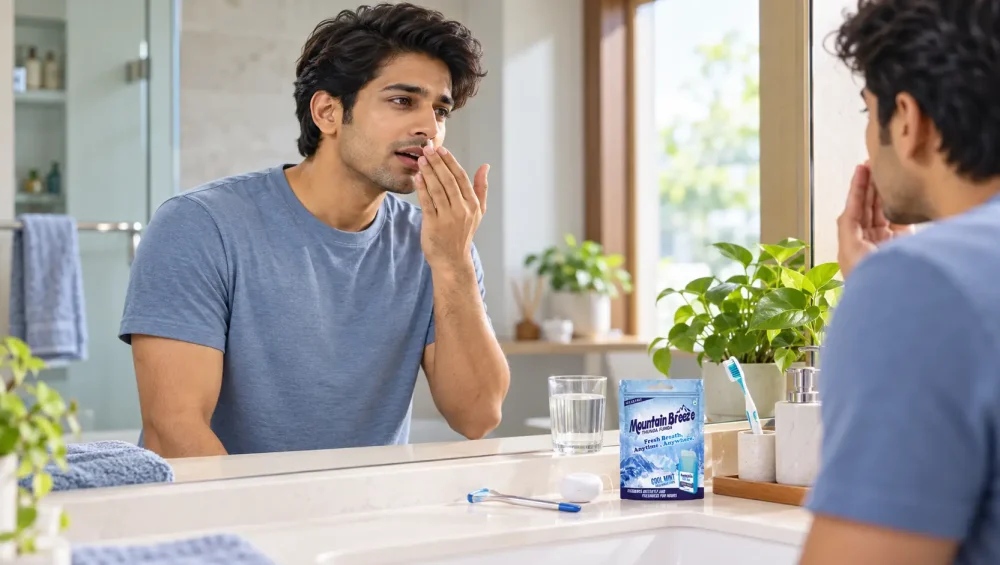
You are about to leave for work, meet someone for coffee or walk into an important meeting.
Then the thought appears:
“Does my breath smell?”
The obvious reaction is to breathe into your hand and smell it.
Unfortunately, that test is not particularly reliable.
One of the frustrating things about bad breath is that the person who has it may find it difficult to notice. Your nose is exposed to your own smells constantly, so your brain can become less sensitive to them over time.
That means you can have perfectly normal breath and worry unnecessarily, or have noticeable bad breath without realising it.
So, how do you tell if you have bad breath?
There is no perfect home test for halitosis, but a few simple checks can give you much better information than breathing into your cupped hands.
Here are five practical bad breath tests, what each one can tell you and what to do if the smell keeps returning.
Why Is It So Hard to Smell Your Own Breath?
Your nose and mouth are closely connected, and you are exposed to your own breath throughout the day.
Over time, your sense of smell can adapt to familiar odours. This is one reason you stop noticing a perfume after wearing it for a while or stop noticing the smell of your own home.
The same effect can make it difficult to judge your own breath accurately.
This is also why repeatedly breathing into your hands may tell you very little.
If you genuinely want to know whether your breath smells, it helps to test material from areas where odour-causing bacteria commonly collect rather than simply smelling the air immediately in front of your face.
5 Simple Ways to Tell If You Have Bad Breath
1. Ask Someone You Trust
This may be the least technologically impressive test on the list, but it is often the most useful.
Ask someone you trust whether your breath smells unpleasant.
A partner, close friend or family member is usually a better choice than a colleague you met ten minutes ago.
Try asking at a normal time rather than immediately after:
- brushing your teeth,
- using mouthwash,
- using a mouth freshener,
- chewing gum, or
- eating a strongly flavoured meal.
You want feedback on your normal breath, not the temporary mint cloud created five minutes earlier.
If someone you trust repeatedly notices an unpleasant smell, take that information seriously, especially if you cannot detect it yourself.
If asking another person feels uncomfortable, a dentist can assess the problem more objectively.
2. Try the Dental Floss Test
Bad breath frequently comes from bacteria and food debris in places that a toothbrush does not clean well.
The spaces between your back teeth are a good example.
Try this:
- Take a clean piece of dental floss.
- Floss gently between several back teeth.
- Look at the floss for trapped debris.
- Smell the used section of floss.
If the floss has a strong unpleasant smell, material between your teeth may be contributing to your breath.
This is particularly useful if you do not clean between your teeth regularly.
However, one smelly piece of floss does not automatically mean you have chronic halitosis.
It is a clue.
Bleeding, swollen or painful gums, particularly when combined with persistent bad breath, should be assessed by a dentist.
3. Try the Tongue Scrape Test
The tongue is one of the most important places to check when investigating bad breath.
Its textured surface can collect:
- bacteria,
- dead cells,
- saliva proteins, and
- tiny food particles.
Much of this material can accumulate toward the back of the tongue.
To perform a simple check:
- Use a clean tongue scraper or a clean spoon.
- Gently move it across the back portion of your tongue.
- Do not scrape so hard that the tongue hurts.
- Wait briefly.
- Smell the material collected on the scraper or spoon.
If it has a strong unpleasant smell, tongue coating may be contributing to your breath.
You may also notice a visible white, cream or yellowish coating.
Gentle tongue cleaning can form part of a normal oral-care routine, but persistent patches, pain, sores or unusual changes should be checked professionally rather than repeatedly scraped.
4. Try the Wrist Test
This is another quick home check.
Instead of breathing into your hand:
- Make sure the inside of your wrist is clean and free from perfume or scented products.
- Lick a small area of the inside of your wrist.
- Allow it to dry briefly.
- Smell the area.
The smell left behind by saliva may give you some idea of how your breath smells.
It is still not a clinical test, and it does not capture odour coming from deeper areas of the mouth or throat.
Think of it as another clue rather than a final diagnosis.
5. Ask a Dentist for a Professional Breath Assessment
If you are genuinely worried about persistent bad breath, this is the most useful test on the list.
A dentist can evaluate more than the smell itself.
They can look for possible causes such as:
- plaque buildup,
- gum disease,
- tooth decay,
- food trapped between teeth,
- tongue coating,
- dry mouth, or
- another oral problem.
Depending on the situation, a healthcare professional may also assess breath from the mouth and nose or use specialised methods to evaluate compounds associated with halitosis.
This becomes particularly important if your bad breath is persistent rather than occasional.
Which Bad Breath Test Is Most Reliable?
If you want the shortest answer:
Feedback from another person or assessment by a dental professional is more reliable than trying to smell your own breath.
Home tests such as the floss, tongue and wrist tests can help identify clues, but none can diagnose every cause of bad breath.
| Bad Breath Test | What It Checks | How Useful Is It? |
| Trusted person | Overall breath odour | Very useful for practical feedback |
| Dental floss test | Odour and debris between teeth | Useful for identifying interdental buildup |
| Tongue scrape test | Tongue coating and odour | Useful when tongue bacteria contribute |
| Wrist test | Odour left by saliva | Useful as a quick clue, but limited |
| Dentist assessment | Breath plus possible underlying causes | Most useful for persistent problems |
Why Breathing Into Your Hand Is Not a Great Bad Breath Test
It is the test everyone knows.
Cup your hand over your mouth, breathe out and immediately smell the air.
The problem is that this does not reproduce the way another person experiences your breath during conversation.
Your nose is also already accustomed to your own smells.
So if the hand test says your breath is fine, that does not prove there is no odour.
And if you become anxious and repeat it every five minutes, you are unlikely to get better information.
What Are the Signs That You Might Have Bad Breath?
Sometimes your mouth gives you clues even when you cannot clearly smell your own breath.
Pay attention to things such as:
- a persistent unpleasant taste,
- a thick or coated tongue,
- dry or sticky mouth,
- food repeatedly getting trapped between teeth,
- bleeding or swollen gums,
- visible plaque buildup,
- tonsil stones, or
- people subtly reacting when you speak closely.
None of these individually proves that you have halitosis.
They simply tell you that it is worth looking more closely at your oral health.
Does a Bad Taste in Your Mouth Mean You Have Bad Breath?
Not always, but the two can occur together.
A lingering bad taste may be associated with:
- food debris,
- tongue coating,
- dry mouth,
- gum problems,
- certain foods or drinks,
- some medicines, or
- other oral or medical conditions.
If you have eaten garlic, for example, both the taste and smell may linger temporarily.
But if you regularly wake up with a bad taste or notice it throughout the day despite good oral hygiene, it deserves more attention.
Can Dry Mouth Be a Sign of Bad Breath?
Dry mouth does not automatically mean your breath smells, but it increases the likelihood of unpleasant breath.
Saliva helps:
- wash food particles away,
- keep oral tissues moist, and
- control the environment in which oral bacteria live.
When saliva flow drops, odour-producing material can remain in the mouth for longer.
This is one reason breath can smell stronger:
- after sleeping,
- when dehydrated,
- during long periods of talking,
- when fasting, or
- when taking certain medicines that cause dry mouth.
Can You Have Bad Breath Even After Brushing?
Yes.
Brushing cleans important tooth surfaces, but bad breath can originate from other areas.
For example:
- bacteria may remain between teeth,
- the tongue may still be coated,
- gum disease may be present,
- the mouth may be unusually dry,
- tonsil stones may be present, or
- another underlying problem may exist.
This is why brushing harder or more frequently is not always the answer.
If you want a broader explanation of the possible causes, read the Mountain Breeze guide to bad breath causes, treatment and prevention.
What Is the Difference Between Bad Breath and Halitosis?
Halitosis is the term commonly used for bad breath.
Occasional unpleasant breath is extremely common.
You might notice it:
- after waking up,
- after eating garlic or onion,
- after drinking coffee,
- after alcohol, or
- after going a long time without food or water.
Persistent halitosis is different.
If the odour keeps returning despite proper brushing, interdental cleaning, tongue cleaning and hydration, it is worth identifying the underlying cause rather than repeatedly covering the smell.
What Causes Bad Breath in the First Place?
Most cases are linked to something happening in or around the mouth.
Possible causes include:
- poor oral hygiene,
- tongue coating,
- food trapped between teeth,
- gum disease,
- tooth decay,
- dry mouth,
- strong-smelling foods,
- smoking or tobacco, and
- tonsil-related problems.
Less commonly, other health problems may contribute.
That is why persistent bad breath should not automatically be treated as a problem that needs a stronger mint.
Our article on common causes of bad breath and how instant mouth fresheners fit in explains this distinction in more detail.
What Should You Do If One of the Tests Suggests Bad Breath?
Do not panic and do not immediately start using five different products.
Start with the basics.
Brush Properly
Brush your teeth thoroughly twice a day using an appropriate fluoride toothpaste.
Pay attention to the gumline and all tooth surfaces rather than brushing only the front teeth you can see in the mirror.
Clean Between Your Teeth
Food and plaque can remain in areas a toothbrush cannot reach effectively.
Use dental floss or another interdental cleaning method recommended by your dentist.
Clean Your Tongue
A coated tongue can contribute significantly to oral odour.
Use a suitable tongue cleaner or toothbrush gently rather than scraping aggressively.
Drink Water
If your mouth feels dry, hydration may help restore a more comfortable oral environment.
Look for Patterns
Ask yourself:
- Does the smell occur mainly after waking?
- Does it appear after coffee?
- Does it happen after long periods without eating?
- Does it remain all day?
- Do your gums bleed?
- Is your mouth constantly dry?
The pattern can provide useful information when you speak with a dentist.
Should You Use a Mouth Freshener Before Testing Your Breath?
No, not if you are trying to understand what your breath normally smells like.
A mouth freshener, mint, chewing gum or mouthwash can temporarily change the smell and make the test less useful.
Check first.
Freshen afterwards if you want to.
This distinction is important because a freshener can be useful socially without telling you anything about the underlying cause of repeated bad breath.
Where Does a Mouth Freshener Fit?
A mouth freshener has a straightforward job.
It provides temporary freshness when you need it.
That can be useful:
- after lunch,
- before a meeting,
- before meeting someone socially,
- during travel, or
- when brushing is not immediately possible.
Mountain Breeze offers sugar-free dissolving mouth freshener strips designed for convenient on-the-go use. You can explore the current Mountain Breeze mouth freshener range here.
If you have never used dissolving breath strips before, read our guide explaining what Paper Mint is and how dissolving breath strips work.
If sugar content matters to you, our guide to sugar-free mouth fresheners and oral health explains what to look for.
Just remember that temporary freshness and treatment are two different things.
Can a Mouth Freshener Hide a Serious Bad Breath Problem?
It can temporarily cover or reduce the perception of the smell.
That is why someone with persistent bad breath may fall into a frustrating cycle:
Freshener.
Fresh breath.
Odour returns.
Another freshener.
If this keeps happening, the better question becomes:
“Why does the smell keep returning?”
That is the point at which oral hygiene and professional assessment matter more than stronger flavour.
When Should You See a Dentist About Bad Breath?
Consider seeing a dentist if bad breath continues for several weeks despite taking care of your mouth properly.
You should also seek professional advice if you notice:
- bleeding gums,
- swollen or painful gums,
- toothache,
- loose adult teeth,
- persistent dry mouth,
- ongoing unpleasant taste, or
- another change in your mouth that concerns you.
A dentist can look for causes that no home breath test can diagnose.
What if the Dentist Says Your Mouth Is Healthy?
If persistent bad breath continues despite good oral hygiene and your dentist does not find an obvious dental cause, further investigation may sometimes be appropriate.
Other factors can include throat, sinus, digestive or medical issues.
Do not attempt to diagnose these based purely on what you think your breath smells like.
Breath odour alone is not specific enough to tell you exactly where a problem is coming from.
A Simple Bad Breath Check Before an Important Moment
If you are about to attend a meeting, interview or social event and simply want a sensible routine, try this:
- Check whether your mouth feels unusually dry.
- Look for obvious food trapped between your teeth.
- Use the floss or tongue test if you are genuinely unsure.
- Drink some water.
- Clean your mouth if brushing is appropriate and available.
- Use a mouth freshener afterwards if you want temporary freshness.
This makes more sense than repeatedly breathing into your hand and becoming increasingly suspicious of yourself.
Do You Need to Test Your Breath Every Day?
No.
If your oral hygiene is good, you have no persistent symptoms and nobody has raised concerns, there is little reason to constantly monitor your breath.
Repeated checking can also make you increasingly uncertain because home tests are imperfect.
Use them when you have a genuine reason to check, not as something you need to perform after every meal or conversation.
Final Thoughts
Figuring out how to tell if you have bad breath is harder than it sounds because your nose is not particularly good at judging a smell it experiences all day.
That is why breathing into your hand is not the best approach.
A trusted person’s feedback, a floss test, a tongue scrape test, a wrist check and, when necessary, a professional dental assessment can give you much more useful information.
The important thing is not to become obsessed with the smell itself.
If your breath occasionally changes after food, coffee, sleep or a long day, that is very different from persistent halitosis.
When bad breath keeps returning, focus on the source.
Clean your teeth properly. Clean between them. Keep your tongue clean. Stay hydrated. Pay attention to your gums and oral health.
And if the problem does not improve, let a dentist help you work out why.
A mouth freshener is useful when you want a quick confidence boost, but knowing what is actually happening in your mouth is ultimately far more valuable than simply covering the smell.
Frequently Asked Questions
How can I tell if my breath smells?
Because it is difficult to accurately smell your own breath, asking someone you trust is one of the most practical methods. You can also smell dental floss used between your back teeth, gently scrape and smell tongue coating, or try the wrist test. Persistent concerns are best assessed by a dentist.
What is the best bad breath test at home?
There is no perfect home test. The floss test and tongue scrape test can reveal odour from common bacterial areas, while feedback from someone you trust can provide a better impression of your overall breath.
Does breathing into your hand tell you if you have bad breath?
Not reliably. Your nose is already accustomed to your own odours, and breathing into cupped hands does not perfectly reproduce the way another person experiences your breath during conversation.
What is the floss test for bad breath?
Floss between your back teeth and then smell the used section of floss. A strong unpleasant odour may suggest that trapped food, plaque or bacteria between the teeth is contributing to your breath.
How does the tongue test for bad breath work?
Gently scrape the back portion of your tongue with a clean tongue scraper or spoon and smell the collected coating. A strong odour may suggest that tongue coating is contributing to bad breath.
Does licking your wrist really show if you have bad breath?
It can provide a rough clue because you can smell the residue left by your saliva after it dries briefly. However, it is not a definitive halitosis test and may miss odour coming from other parts of the mouth or throat.
Can you have bad breath without knowing it?
Yes. People can become accustomed to their own smell and may have difficulty detecting their breath accurately. This is why trusted feedback or professional assessment can be useful.
Does a bad taste mean my breath smells?
Not always, but an unpleasant taste and bad breath can occur together. Persistent bad taste can be associated with dry mouth, oral bacteria, gum problems, food debris or other causes.
Why does my breath smell even after brushing?
Brushing does not clean every possible source of bad breath. Bacteria between teeth, tongue coating, gum disease, tooth decay, dry mouth, tonsil-related issues and other conditions can continue to cause odour.
When should I see a dentist for bad breath?
See a dentist if bad breath continues for several weeks despite good oral hygiene or if you also have bleeding gums, swelling, tooth pain, loose teeth or other ongoing oral symptoms.
Can a mouth freshener tell me whether I have bad breath?
No. A mouth freshener changes how your mouth tastes and smells temporarily. If you want to assess your normal breath, test it before using a freshener, mint, gum or mouthwash.
Can I use a mouth freshener after checking my breath?
Yes. A mouth freshener can provide temporary freshness after you have assessed your breath. It should complement normal oral hygiene rather than replace brushing, interdental cleaning, tongue cleaning or dental care.
Disclaimer: This article is intended for general educational purposes and does not provide a medical or dental diagnosis. Home breath tests can provide clues but are not definitive. Persistent bad breath or other ongoing oral symptoms should be evaluated by a qualified dentist or healthcare professional.


