
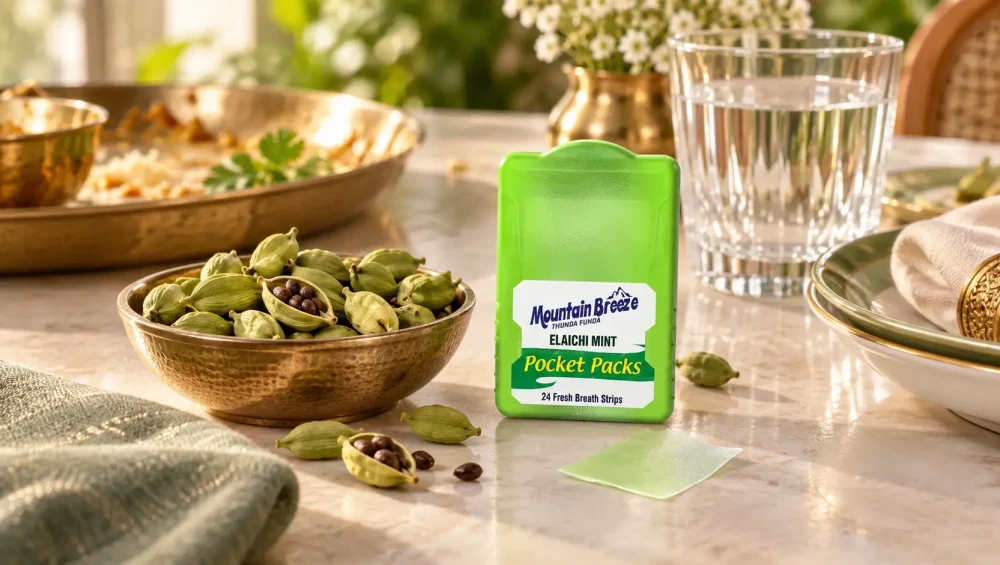
Elaichi mouth freshener strips compared with fresh green cardamom pods after a meal

Elaichi Mouth Freshener vs Green Cardamom Pods: Which Is Better After Meals?

For generations, Indians have reached for a small green elaichi after a meal.

Crack the pod, chew the aromatic seeds and the strong flavour quickly replaces the taste of garlic, onion, spices or rich gravies left behind after food.

Today, there is another option: the elaichi mouth freshener.

Instead of carrying whole cardamom pods, modern mouth fresheners can deliver a cardamom-inspired flavour in formats such as mints, sprays or dissolving strips.

So which one makes more sense after meals: traditional green cardamom pods or an elaichi mouth freshener?

The answer depends on what you value most. If you enjoy chewing a whole spice and want the simplest possible ingredient, green cardamom is difficult to beat. If you want something compact, predictable and easy to use at work or while travelling, a modern mouth freshener can be more practical.

Let us compare them properly.

What Is Green Cardamom?

Green cardamom, commonly called green elaichi in India, is an aromatic spice made from small green pods containing dark seeds.

The pods have a distinctive sweet, warm and slightly minty aroma. That strong flavour is one reason many Indian households and restaurants traditionally offer cardamom after meals.

You can chew the seeds directly or lightly crush the pod first.

When plain green cardamom is used on its own, there is no added sugar, coating or separate flavouring. You are simply chewing the spice itself.

If you are interested in other kitchen ingredients traditionally used for freshness, Mountain Breeze has a broader guide to natural mouth fresheners including cardamom and fennel seeds.

What Is an Elaichi Mouth Freshener?

An elaichi mouth freshener is a prepared product designed to give you the familiar flavour of cardamom in a convenient format.

Depending on the product, this could be a candy, coated seed, mukhwas blend, mint or dissolving strip.

This distinction matters because two products labelled “elaichi mouth freshener” can have completely different ingredient lists.

One may contain sugar-coated seeds. Another may be a traditional mukhwas blend. A third may use cardamom flavour in a sugar-free dissolving strip.

So do not judge a product only by the word “elaichi”. Check the format and ingredient information as well.

Elaichi Mouth Freshener vs Green Cardamom Pods: Quick Comparison

FactorGreen Cardamom PodsElaichi Mouth Freshener Strip
FormatWhole natural spicePrepared dissolving strip
FlavourNatural, aromatic and intenseConsistent cardamom-inspired flavour
Chewing requiredYesNo
PortabilityEasy, but pods need a containerVery compact and pocket-friendly
Added sugarNone in plain cardamomDepends on the product
Flavour consistencyCan vary between podsUsually more consistent
Best suited forHome and traditional after-meal useOffice, travel, restaurants and on-the-go use

Which Gives a More Natural Experience?

If natural simplicity is your only priority, plain green cardamom wins.

You crack open the pod and chew the seeds. There is no need to recreate the flavour because you are consuming the spice itself.

For many people, that is part of the appeal.

The taste also feels familiar. It is the same elaichi used across Indian cooking, chai, desserts and traditional after-meal habits.

A prepared mouth freshener offers a different proposition. It trades the whole-spice experience for convenience and consistency.

Neither is automatically better. They simply solve different problems.

Which Is More Convenient After Meals?

This is where modern formats have a clear advantage.

Green cardamom is easy enough to keep at home. Put a bowl on the dining table and the job is done.

Outside the house, however, things become less convenient.

You need somewhere to store the pods. Once you chew them, you may have fibrous pod material or seeds left in your mouth. Carrying loose spices in a work bag is also not everyone’s idea of elegant organisation.

A dissolving strip is designed for a different lifestyle.

Take out a strip, place it on your tongue and let it dissolve. No chewing and no loose seeds to dispose of afterwards.

That makes an elaichi-flavoured strip particularly practical:

  • after lunch at work,
  • before a meeting,
  • during travel,
  • after eating at a restaurant,
  • before a social event, or
  • when carrying loose cardamom is inconvenient.

For a broader look at after-meal options, read our guide to choosing a mouth freshener after food in India.

What About Sugar?

This is one of the most important differences to check.

Plain green cardamom pods contain no added sugar.

But an elaichi-flavoured packaged freshener may or may not be sugar-free.

Sweetened cardamom, coated seeds, candies and some mukhwas products can contain added sugar.

If you use a mouth freshener frequently throughout the day, it is worth reading the ingredient label rather than assuming every cardamom product is the same.

Mountain Breeze Elaichi Mint strips are positioned as a sugar-free option. You can also read our complete guide on choosing a sugar-free mouth freshener.

Does Green Cardamom Actually Freshen Your Breath?

Green cardamom has a naturally powerful aroma.

Chewing the seeds can temporarily replace lingering food flavours with a strong cardamom taste, which is why elaichi has traditionally been used after meals.

But there is an important distinction between freshening your mouth and treating the cause of persistent bad breath.

If you ate garlic-heavy food and want a more pleasant taste afterwards, cardamom may feel refreshing.

If you have persistent bad breath caused by plaque, gum problems, dry mouth or another oral condition, chewing cardamom does not remove the underlying problem.

The same limitation applies to a modern mouth freshener.

Neither should replace brushing, tongue cleaning, interdental cleaning or professional dental care.

Is Elaichi Better Than Saunf After Meals?

Both cardamom and fennel seeds are traditional Indian after-meal choices, but their flavour profiles are very different.

Fennel seeds have a milder, sweeter and more herbaceous taste.

Green cardamom is stronger, warmer and more aromatic.

People who want something gentle to chew after every meal often prefer saunf. People who want a more noticeable aromatic flavour may prefer elaichi.

Traditional mukhwas frequently combines fennel with other ingredients such as sesame, coriander, coconut, sugar coatings or spices.

If you regularly eat packaged mukhwas, our guide to what is actually inside traditional mukhwas explains what to check on the ingredient list.

Whole Green Cardamom vs Flavoured Elaichi Products

Another distinction is worth making.

Not every product that tastes like elaichi contains whole cardamom pods or cardamom seeds.

Food products can use added flavour to create a cardamom profile.

This is not automatically good or bad. It simply means buyers should understand what they are choosing.

If your priority is eating the actual spice, choose whole cardamom.

If your priority is getting a familiar elaichi flavour in a specific format, such as a dissolving strip, then an elaichi-flavoured mouth freshener may fit better.

Where Does Mountain Breeze Elaichi Mint Fit?

Mountain Breeze Elaichi Mint takes the second approach.

It is a sugar-free dissolving fresh breath strip with added Elaichi Mint, or cardamom, flavour.

Instead of chewing a cardamom pod, you place the strip on your tongue and allow it to dissolve.

The main advantage is convenience.

You get a familiar elaichi-inspired flavour in a compact format that can be carried in a pocket, handbag or work bag.

You can see the Elaichi Mint flavour alongside the other Mountain Breeze flavours on the Mountain Breeze product range page.

For current pack sizes and buying options, browse the Mountain Breeze mouth freshener collection.

Which Option Is Better at Home?

At home, plain green cardamom makes plenty of sense.

You can keep a small jar in the kitchen or dining area and chew a pod after a meal whenever you want.

There is no packaging to carry around and no need for a specially prepared product.

If you already buy good-quality cardamom for cooking or chai, using the same spice after meals is simple.

For home use, convenience is rarely a major problem.

Which Option Is Better at Work?

Work is different.

After lunch, you may have only a few minutes before another meeting.

Opening a container, cracking a pod and chewing seeds at your desk can work, but many people prefer something quicker and more discreet.

A dissolving strip can be used without chewing and takes up very little space.

So if portability and discretion matter more than the traditional experience, an elaichi mouth freshener strip is usually the easier option.

Which Is Better While Travelling?

Again, convenience becomes the deciding factor.

Green cardamom travels reasonably well in a sealed container, but loose pods can crack or spill inside a bag.

A compact mouth freshener pack is easier to carry on:

  • flights,
  • train journeys,
  • road trips,
  • business travel, and
  • long days outside the house.

If travel is occasional and you already carry cardamom, there is no compelling reason to change.

If you want something specifically designed for a pocket or small bag, strips are more practical.

Which One Is Better After a Heavy Indian Meal?

After biryani, butter chicken, dal makhani, garlic naan or another strongly flavoured meal, you may want something aromatic enough to replace the lingering aftertaste.

Both options can do that in different ways.

Green cardamom gives you the actual spice experience. An elaichi mouth freshener gives you a more controlled and convenient cardamom-inspired flavour.

If you are sitting comfortably at home, whole cardamom may be all you need.

If you are leaving a restaurant and heading straight into a conversation, meeting or car journey, the packaged format may be easier.

What Should You Check Before Buying an Elaichi Mouth Freshener?

Do not buy entirely on the front-of-pack flavour name.

Check:

  • Added sugar: Is the product sugar-free or sweetened?
  • Format: Is it a candy, mukhwas, coated seed, mint or dissolving strip?
  • Ingredients: What else is present besides the elaichi flavour?
  • Portability: Is the pack practical for where you plan to use it?
  • Serving style: Does it require chewing or does it dissolve?
  • Flavour intensity: Do you actually enjoy strong cardamom flavour?

A little label reading prevents a lot of assumptions.

So, Which Is Better: Green Cardamom or Elaichi Mouth Freshener?

There is no universal winner.

Choose green cardamom pods if you:

  • want the actual spice,
  • prefer a single simple ingredient,
  • enjoy chewing cardamom seeds,
  • mostly use it at home, or
  • do not mind carrying loose pods.

Choose an elaichi mouth freshener if you:

  • want a more portable option,
  • prefer not to chew seeds,
  • need something discreet at work,
  • travel frequently,
  • want consistent flavour, or
  • prefer a prepared sugar-free format.

The better option is the one that fits the situation in which you actually use it.

Final Thoughts

Green cardamom has earned its place as a traditional Indian after-meal freshener for a reason. It is aromatic, familiar and wonderfully simple.

A modern elaichi mouth freshener does not need to replace that tradition.

It simply solves a different problem.

Whole cardamom works beautifully when you have the spice available and do not mind chewing it. A dissolving elaichi strip is better suited to people who want the flavour in a pocket-friendly, no-chewing format for work, travel and social situations.

So the decision is less about which one is objectively “better” and more about what you need after your meal.

At the dining table, you may choose the pod.

Five minutes before a client meeting, the strip suddenly starts looking very clever.

Frequently Asked Questions

Is green cardamom a natural mouth freshener?

Green cardamom is traditionally chewed after meals because of its strong aromatic flavour. Plain cardamom pods contain no added sugar or flavouring and can provide temporary freshness after food.

What is an elaichi mouth freshener?

An elaichi mouth freshener is a prepared product designed to provide cardamom flavour after meals or whenever fresh breath is desired. It may come as a mint, mukhwas, coated seed, candy or dissolving strip, so ingredients vary between products.

Is cardamom mouth freshener the same as green cardamom?

Not necessarily. Green cardamom is the actual spice. A cardamom mouth freshener may contain cardamom, cardamom flavour or a mixture of several ingredients. Always check the label if the distinction matters to you.

Does green cardamom contain added sugar?

Plain whole green cardamom does not contain added sugar. However, sweetened cardamom products or packaged mouth fresheners may contain added sugar, so check the ingredient information.

Which is better after meals, saunf or elaichi?

It depends on your taste. Fennel seeds have a milder and slightly sweet flavour, while green cardamom is stronger and more aromatic. Both are traditionally used after meals in India.

Can I use an elaichi mouth freshener every day?

That depends on the ingredients and usage directions of the specific product. If you use a packaged mouth freshener frequently, check its sugar content and follow the instructions provided by the manufacturer.

Is Mountain Breeze Elaichi Mint made from whole cardamom pods?

Mountain Breeze lists Elaichi Mint as a sugar-free dissolving fresh breath strip containing added Elaichi Mint, or cardamom, flavour. It is a flavoured strip rather than a whole green cardamom pod.

Is an elaichi mouth freshener better than chewing cardamom?

Neither is universally better. Whole cardamom is simpler and more traditional, while an elaichi mouth freshener can be more convenient, portable and consistent for use outside the home.

Can cardamom replace brushing or tongue cleaning?

No. Green cardamom and mouth fresheners can provide temporary freshness but do not remove plaque, clean between teeth or treat persistent bad breath. Normal oral hygiene remains essential.


Young Indian adult concerned about tonsil stones and recurring bad breath

Tonsil Stones and Bad Breath: Why the Smell Keeps Coming Back & What Actually Helps

You brush your teeth, clean your tongue and use a mouth freshener before leaving home. Your breath feels fine for a while.

Then the unpleasant smell returns.

If this keeps happening despite reasonably good oral hygiene, there may be something hiding further back in your mouth: tonsil stones.

Tonsil stones and bad breath are closely connected because these small white or yellow deposits can contain bacteria, food debris and other material trapped inside the natural folds of the tonsils.

The frustrating part is that brushing your teeth alone may not reach them. That is why someone can have clean teeth and still wonder why the smell keeps coming back.

Here is how tonsil stones form, why they can smell so strong, what may help, and when it is better to stop experimenting at home and speak with a dentist or ENT specialist.

What Are Tonsil Stones?

Tonsil stones are small hardened deposits that form inside tiny folds and pockets in the tonsils.

The medical term for them is tonsilloliths.

Your tonsils are not perfectly smooth. They contain small grooves called tonsillar crypts. In some people, these crypts are deeper or more prominent than in others.

Material can become trapped inside them, including:

  • food particles,
  • dead cells,
  • mucus,
  • bacteria,
  • saliva components, and
  • minerals such as calcium.

Over time, this trapped material can harden into small white or yellow lumps.

Some tonsil stones are tiny enough that you never notice them. Others become visible at the back of the throat or cause symptoms such as bad breath, throat discomfort or the sensation that something is stuck.

Why Do Tonsil Stones Cause Bad Breath?

The smell is largely connected to the bacteria and organic material trapped in and around the stone.

Bacteria in the mouth can break down proteins and release unpleasant-smelling compounds, including volatile sulphur compounds.

These are also involved in many ordinary cases of bad breath, or halitosis.

A tonsil stone gives bacteria a convenient place to collect at the back of the throat. If the stone remains there, simply brushing the front of your teeth does not remove the source.

This is why the smell can disappear temporarily after brushing, rinsing or using a mouth freshener and then gradually return.

For a broader look at other possible causes, read our guide to the common causes of bad breath and how temporary fresheners fit into oral care.

What Does a Tonsil Stone Smell Like?

Searches such as “tonsil rocks smell” exist for a good reason.

People who have experienced tonsil stones often describe the smell as unusually strong, unpleasant or sulphur-like.

The exact smell can vary, so you should not try to diagnose tonsil stones based on odour alone.

Persistent bad breath can also come from:

  • gum disease,
  • tooth decay,
  • dry mouth,
  • a coated tongue,
  • sinus or throat problems,
  • strong foods,
  • smoking, or
  • other health conditions.

The important clue with tonsil stones is usually recurring bad breath together with visible white or yellow material in the tonsil area or other throat symptoms.

Common Symptoms of Tonsil Stones

Bad breath is one of the best-known symptoms, but it is not the only one.

You may also notice:

  • small white or yellow spots on the tonsils,
  • a bad taste in the mouth,
  • the feeling that something is stuck in your throat,
  • mild throat irritation,
  • coughing,
  • difficulty swallowing in some cases, or
  • ear discomfort even though the problem is in the throat.

Some people have tonsil stones without noticing any symptoms at all.

Why Do Tonsil Stones Keep Coming Back?

This is where the real frustration begins.

You remove one stone, your breath improves, and a few weeks later another appears.

That happens because removing a stone does not change the shape of the tonsil crypt where it formed.

If you naturally have deep tonsillar crypts, debris may continue collecting inside them.

Recurring tonsil stones may also be more likely when you have:

  • frequent tonsillitis,
  • large or deep tonsillar crypts,
  • poor oral hygiene,
  • dehydration,
  • persistent mucus or postnasal drip, or
  • ongoing bacterial buildup in the mouth.

This is why prevention is usually more useful than repeatedly trying to dig individual stones out.

Can Good Oral Hygiene Help Prevent Tonsil Stones?

It can help reduce the amount of debris and bacteria available to become trapped, although it cannot change your tonsil anatomy.

A good daily routine includes:

  • brushing twice a day,
  • cleaning between your teeth,
  • cleaning your tongue,
  • drinking enough water, and
  • rinsing your mouth after meals when brushing is not practical.

Good oral hygiene is especially important because tonsil stones are not the only possible source of bad breath.

If plaque, tongue coating and gum problems are also present, removing a tonsil stone may improve the smell without eliminating it completely.

Does Tongue Scraping Help With Tonsil Stone Breath?

A tongue cleaner or gentle tongue scraping can help reduce one major source of oral bacteria.

However, cleaning your tongue does not physically remove a stone lodged inside a tonsil crypt.

Think of it as reducing the overall bacterial load in the mouth rather than directly treating the tonsil stone.

This distinction matters because someone may clean their tongue perfectly and still experience recurring odour from the back of the throat.

If your breath improves considerably after tongue cleaning, the tongue itself may have been contributing to the problem as well.

Does a Salt Water Rinse Help Tonsil Stones?

A warm salt water rinse or gargle is one of the simplest measures commonly recommended for tonsil stones.

Gargling may help:

  • loosen small stones,
  • clear some debris from the tonsil area,
  • keep the mouth and throat cleaner, and
  • reduce temporary throat discomfort.

It is not guaranteed to remove a deeply embedded or large stone.

If a stone does not move easily, aggressive poking is not a clever next step.

Can Mouthwash Help With Tonsil Stones?

A mouthwash for tonsil stones may help with overall oral hygiene and temporary bad breath, but mouthwash cannot reliably remove a hardened stone sitting deep inside a tonsil crypt.

The more realistic role of mouth rinse is to help reduce bacteria and freshen the mouth.

It should be used alongside brushing, interdental cleaning and tongue cleaning rather than instead of them.

If you use mouthwash frequently and struggle with dry mouth, ask your dentist whether your current product is appropriate. Dry mouth itself can make bad breath more noticeable.

Can a Water Flosser Remove Tonsil Stones?

There is significant search interest around water flossers for tonsil stones, but this is one area where caution matters.

Some clinical guidance mentions gentle irrigation as one possible way to dislodge small tonsil stones.

However, tonsil tissue is delicate.

A high-pressure stream aimed directly at the tonsil can cause pain, bleeding or tissue injury.

If you are considering irrigation, especially for recurring or difficult stones, speak with a dentist or ENT specialist about whether it is appropriate and how to do it safely.

Do not assume that maximum pressure means maximum effectiveness.

Should You Remove Tonsil Stones Yourself?

Small stones sometimes loosen naturally while coughing, gargling or eating.

People are often tempted to remove visible stones at home using fingers, metal tools, toothpicks or anything else that happens to be within reach.

That can damage the tonsil and introduce infection.

Avoid:

  • sharp objects,
  • metal dental tools used without professional training,
  • aggressive digging,
  • high-pressure irrigation, and
  • continuing if the tonsil starts bleeding.

If the stone is large, deeply embedded, painful or difficult to remove, let a healthcare professional handle it.

What About Hydrogen Peroxide Mouthwash?

Hydrogen peroxide rinses receive plenty of online attention for oral problems.

That does not mean you should start mixing strong solutions at home and gargling them around sensitive throat tissue.

Incorrect concentrations or repeated use can irritate oral tissues.

If you are considering a medicated or antiseptic rinse specifically because of recurring tonsil stones, ask your dentist or ENT specialist which product and concentration are appropriate for you.

Does Oil Pulling Remove Tonsil Stones?

Oil pulling is another popular oral-care practice, but it should not be presented as a proven way to remove tonsil stones.

Swishing oil may make the mouth feel different, but it does not physically reach deep tonsillar crypts in a predictable way or remove calcified stones reliably.

Do not replace brushing, flossing, tongue cleaning or professional care with oil pulling.

Why Does the Smell Return After Using a Mouth Freshener?

This is easy to understand once you separate the symptom from the source.

A mouth freshener changes how your mouth tastes and smells temporarily.

If a tonsil stone remains in place, the source of the odour remains too.

Once the mint sensation fades, the unpleasant smell may become noticeable again.

That does not mean the freshener failed. It means it was doing a different job.

Mountain Breeze dissolving strips are designed for temporary on-the-go freshness. You can explore the Mountain Breeze mouth freshener range here.

If you are unfamiliar with dissolving strips, our Paper Mint guide explains how breath strips work and when they are useful.

Can a Sugar-Free Mouth Freshener Help?

A sugar-free freshener can be useful when you want temporary freshness without using a conventional sugary mint.

It still does not remove a tonsil stone.

The right way to think about it is:

oral hygiene and appropriate tonsil care address the underlying problem, while a mouth freshener helps with temporary social freshness.

If you use fresheners frequently, read our guide to sugar-free mouth fresheners and oral health.

A Practical Routine for Recurring Tonsil Stone Breath

If tonsil stones are a recurring problem, a simple routine may help reduce the amount of debris and bacteria collecting in the mouth and throat.

  1. Brush thoroughly twice a day.
  2. Clean between your teeth daily.
  3. Use a tongue cleaner gently.
  4. Drink water regularly throughout the day.
  5. Rinse your mouth after meals.
  6. Consider warm salt-water gargling if appropriate for you.
  7. Avoid smoking.
  8. Do not aggressively dig at your tonsils.
  9. Use a mouth freshener only when you need temporary freshness.
  10. See a dentist or ENT specialist if stones keep returning.

What if You Cannot See a Tonsil Stone?

Not every case of persistent bad breath is caused by tonsil stones.

If you cannot see anything but the smell keeps returning, other causes should be considered.

These include:

  • gum disease,
  • tooth decay,
  • dry mouth,
  • a heavily coated tongue,
  • sinus or throat problems,
  • acid reflux, or
  • other medical conditions.

Trying to diagnose yourself entirely from smell is unreliable.

If you have persistent halitosis despite good oral hygiene, a dentist is usually a sensible first place to start.

When Should You See an ENT Specialist?

Occasional small tonsil stones are usually not dangerous, but recurring or troublesome stones deserve proper assessment.

Speak with a healthcare professional if:

  • tonsil stones keep returning frequently,
  • the stones are large or deeply embedded,
  • you have difficulty swallowing,
  • you experience significant throat pain,
  • the tonsil bleeds when you try to remove a stone,
  • you have repeated tonsil infections,
  • you notice significant one-sided swelling, or
  • bad breath persists despite addressing obvious oral causes.

An ENT specialist can examine the tonsils properly and discuss options if recurrent stones are affecting your quality of life.

Can Tonsil Stones Be Prevented Completely?

Not always.

If your tonsils naturally contain deep crypts, you may remain more prone to developing stones even with excellent oral hygiene.

However, reducing debris and bacterial buildup may lower the chance of stones forming or becoming troublesome.

Good oral care, tongue cleaning, hydration and rinsing after meals are sensible habits whether or not tonsil stones are present.

Final Thoughts

Tonsil stones and bad breath can become a frustrating cycle.

You brush, rinse and freshen your mouth. The smell improves. Then it returns because the actual source may still be sitting inside a tonsil crypt at the back of your throat.

The best approach is not to keep covering the smell with stronger products.

Focus on good oral hygiene, tongue cleaning, hydration and gentle throat care. Small stones may loosen naturally or with simple measures such as gargling.

If the stones are large, painful, difficult to remove or keep coming back, speak with a dentist or ENT specialist rather than repeatedly digging at sensitive tonsil tissue.

And when you simply need temporary fresh breath before work, travel or a conversation, a mouth freshener can help with the symptom while you deal with the actual cause properly.

Frequently Asked Questions

Do tonsil stones cause bad breath?

Yes. Bad breath is one of the most common symptoms of tonsil stones. Bacteria and trapped organic material inside the stones can produce unpleasant-smelling compounds.

Why do tonsil stones smell so bad?

Tonsil stones contain bacteria, food debris, dead cells and other material. Bacteria breaking down this material can release sulphur-containing compounds that create a strong unpleasant smell.

How do you remove tonsil stones?

Small tonsil stones may loosen naturally, through coughing or with gentle warm salt-water gargling. Avoid sharp tools or aggressive removal. Large, painful or difficult stones should be assessed by a dentist or ENT specialist.

Does mouthwash help tonsil stones?

Mouthwash can support overall oral hygiene and temporarily improve bad breath, but it may not physically remove a hardened stone lodged inside a tonsil crypt.

Can salt water remove tonsil stones?

Warm salt-water gargling may help loosen small stones and clear debris around the tonsils. It will not necessarily remove large or deeply embedded stones.

Can a water flosser remove tonsil stones?

Gentle irrigation is sometimes used for small stones, but tonsils are delicate and high-pressure streams can cause injury or bleeding. Ask a dentist or ENT specialist before using a water flosser directly on the tonsils.

Why do my tonsil stones keep coming back?

Recurring stones are often associated with deep tonsillar crypts where debris repeatedly collects. Frequent tonsil infections, dehydration and bacterial buildup may also contribute.

Can tongue scraping prevent tonsil stones?

Tongue scraping cannot change the structure of the tonsils, but it can reduce tongue coating and oral bacteria as part of good oral hygiene. This may help reduce one source of bad breath.

Will a mouth freshener get rid of tonsil stone breath?

A mouth freshener can temporarily improve how your breath smells, but it cannot remove a tonsil stone or treat the underlying cause. If the stone remains, the odour may return once the freshening effect fades.

Disclaimer: This article is for general educational purposes only and does not replace diagnosis or treatment from a dentist, doctor or ENT specialist. Seek professional advice for persistent, painful or recurrent tonsil stones.

Young adult with braces managing bad breath and oral hygiene after a meal

Bad Breath With Braces or Clear Aligners: Why It Happens & What Actually Helps

You brush your teeth, straighten your smile and follow your orthodontic treatment carefully. So why does your breath sometimes seem worse after getting braces or clear aligners?

Bad breath with braces is not unusual. Brackets, wires and other orthodontic appliances create extra places where food particles and plaque can collect. Clear aligners create a different challenge because the trays cover your teeth for many hours each day.

The good news is that braces or aligners do not automatically mean bad breath. In most cases, the problem comes down to food trapping, plaque, tongue coating, dry mouth or cleaning habits that need to change slightly during orthodontic treatment.

Here is what actually causes the problem, what helps, and where a mouth freshener fits without pretending to replace proper orthodontic oral care.

Can Braces Cause Bad Breath?

Braces themselves do not produce an unpleasant smell.

The challenge is that orthodontic braces add brackets, wires and small spaces around the teeth that can make normal cleaning more difficult.

Food that would normally be easy to remove can become trapped around brackets or underneath wires. If it stays there, oral bacteria begin breaking it down. Plaque can also accumulate in these harder-to-reach areas.

That combination may lead to:

  • unpleasant breath,
  • a stale taste in the mouth,
  • gum irritation,
  • visible plaque around brackets, and
  • higher risk of cavities or white marks if oral hygiene remains poor.

If you experience bad breath even without orthodontic appliances, our guide to the common causes of bad breath explains the broader causes in more detail.

Why Is Bad Breath More Common With Braces?

1. Food Gets Trapped Around Brackets and Wires

This is one of the simplest explanations.

Rice, bread, vegetables, paneer, meat fibres and other everyday foods can become caught around braces. Sometimes you can feel them immediately. Other times a small piece remains hidden behind a wire for hours.

If you cannot brush after a meal, rinsing thoroughly with water can help loosen obvious food particles until you can clean properly.

A quick mirror check after lunch is also surprisingly useful.

2. Plaque Has More Places to Collect

Plaque is a sticky bacterial film that forms continuously on teeth.

With braces, there are more edges and hard-to-reach spaces around the brackets. This means your old brushing routine may no longer be enough.

Plaque left around braces can contribute not only to unpleasant breath but also to gum inflammation and enamel problems.

3. Brushing With Braces Requires More Attention

Brushing with braces is not simply brushing the visible front surface of each tooth.

You need to clean around the bracket, above and below the wire, along the gumline and on the chewing and inner surfaces of your teeth.

An orthodontist may also recommend an interproximal or interdental brush to reach spaces a normal toothbrush cannot easily access.

If you rush through brushing because the braces make it inconvenient, food and plaque are more likely to remain behind.

4. The Tongue Can Still Be the Real Problem

It is easy to blame your braces because they are new and obvious.

Meanwhile, your tongue may be quietly causing much of the odour.

The textured surface of the tongue can hold bacteria, dead cells and food debris. Cleaning the teeth perfectly while ignoring the tongue may therefore leave an important source of bad breath untouched.

Clean your tongue gently as part of your normal oral-care routine.

Can Clear Aligners Cause Bad Breath Too?

Yes, although the mechanism is slightly different.

Clear aligners are removable plastic trays that fit closely over the teeth. Because they cover the teeth for long periods, anything left underneath them can remain trapped against the tooth surface.

If you eat lunch, quickly rinse your mouth and immediately put your aligners back over food residue or plaque, you are effectively covering that material for the next several hours.

The aligners themselves can also develop an unpleasant smell if they are not cleaned properly.

Why Do Clear Aligners Start Smelling?

A clear aligner tray spends many hours in direct contact with saliva, teeth and the oral environment.

Odour can become noticeable when:

  • trays are reinserted over teeth that have not been cleaned,
  • aligners are not cleaned regularly,
  • you drink beverages other than water while wearing them,
  • plaque builds up on the tray surface, or
  • the mouth becomes dry.

Clear aligners should normally be removed before eating and before drinking anything other than water, according to the instructions provided by your orthodontist.

Before putting them back in, your teeth and the aligners need appropriate cleaning.

Braces vs Clear Aligners: Why the Breath Problem Is Different

IssueBracesClear Aligners
Food trappingFood can become stuck around brackets and wiresFood residue can become trapped underneath trays if teeth are not cleaned first
Cleaning challengeRequires cleaning around fixed hardwareRequires cleaning both teeth and removable trays
EatingBraces remain in placeAligners should generally be removed
Main breath riskPlaque and trapped food around bracesTrapped bacteria, plaque and unclean trays
Quick post-meal stepRinse, then clean around braces properlyRemove trays for food, clean teeth and trays before reinserting

How to Keep Your Breath Fresh With Braces

1. Brush Properly After Meals When Possible

If your orthodontist has instructed you to brush after meals, follow that routine carefully.

Spend enough time cleaning:

  • above each bracket,
  • below each bracket,
  • around the wire,
  • along the gumline,
  • behind the teeth, and
  • on the chewing surfaces.

Do not scrub aggressively. Better cleaning is about reaching the right areas, not attacking your braces with more force.

2. Use an Interdental Brush if Recommended

An interdental or interproximal brush is small enough to clean around brackets and wires where a normal toothbrush struggles to reach.

For many people, this becomes one of the most useful tools during orthodontic treatment.

Your orthodontist can show you the correct size and technique for your particular appliance.

3. Floss Every Day

Flossing can feel frustrating with braces, particularly at first.

Unfortunately, bacteria are not impressed by inconvenience.

Cleaning between your teeth remains important because ordinary brushing does not completely clean these contact areas.

Depending on your braces, your orthodontist may recommend floss threaders, orthodontic floss, an interdental brush or another suitable cleaning method.

4. Rinse With Water After Eating

You will not always have a toothbrush available.

If you have just eaten lunch at college, work or while travelling, rinse your mouth thoroughly with plain water.

This does not replace brushing, but it can help dislodge loose particles and make the mouth feel cleaner until proper cleaning is possible.

5. Clean Your Tongue

A coated tongue can continue producing unpleasant breath even when your braces are spotless.

Use a toothbrush or suitable tongue cleaner gently and consistently.

6. Stay Hydrated

Dry mouth makes bad breath easier to notice because saliva normally helps wash the mouth and control debris.

Drink water throughout the day, particularly if you talk frequently, exercise, work in air-conditioned environments or consume a lot of tea or coffee.

How to Keep Your Breath Fresh With Clear Aligners

Remove Aligners Before Eating

Do not eat with your aligners in unless your orthodontist has specifically told you otherwise.

Remove them before meals and snacks. Water is generally the safest beverage while clear aligners are being worn.

Do Not Put Aligners Back Over Dirty Teeth

This is one of the most important habits.

Imagine eating lunch, leaving small food particles around your teeth and then covering everything with a close-fitting plastic tray for several hours.

Not ideal.

Clean your teeth according to your orthodontist’s instructions before reinserting the aligners.

Clean the Aligners Themselves

Your teeth may be perfectly clean while the trays themselves still carry plaque or odour.

Follow the cleaning instructions provided for your particular aligner system. Avoid improvising with very hot water or harsh household cleaners because they may damage the material.

Keep the Aligner Case Clean Too

The case is easy to forget.

If you repeatedly place clean aligners into a dirty or damp case, you are not doing yourself many favours.

Clean the case regularly and allow it to dry properly according to the manufacturer’s guidance.

Does Mouthwash Help With Braces?

A mouthwash for braces may be useful as part of an orthodontist-recommended oral-care routine, but it does not replace physical plaque removal.

Brushing and cleaning between the teeth remain essential because mouthwash cannot simply wash away everything stuck around brackets and wires.

Your orthodontist or dentist may recommend a fluoride mouth rinse depending on your individual needs.

Do not choose a mouthwash purely because it promises the strongest possible flavour. The goal is oral health, not making your mouth taste like an industrial mint factory for twenty minutes.

What Foods Make Braces Breath Worse?

Strong-smelling foods such as onion and garlic can affect anyone’s breath, with or without braces.

The bigger issue with braces is food that becomes physically stuck.

Sticky, chewy and hard foods can be difficult to clean from orthodontic appliances and may also damage brackets or wires. Follow the food restrictions given by your orthodontist.

After normal meals, pay particular attention to anything fibrous or sticky enough to remain around the appliance.

Can You Use a Mouth Freshener With Braces?

A mouth freshener can provide temporary freshness, but it should come after sensible oral hygiene, not instead of it.

Hard mints and chewing gum may not always be suitable for people with braces because orthodontists commonly advise avoiding hard or sticky products that can interfere with appliances.

Dissolving breath strips use a different format because they dissolve on the tongue and do not require chewing.

Mountain Breeze offers sugar-free dissolving mouth freshener strips for on-the-go freshness. You can explore the Mountain Breeze mouth freshener range here.

If you want to understand how dissolving strips work before choosing one, read our complete guide to paper mint and dissolving breath strips.

For people using mouth fresheners regularly, our guide to sugar-free mouth fresheners and oral health explains why the formulation matters.

Always follow your orthodontist’s instructions about what you can consume during treatment.

Can You Use a Mouth Freshener While Wearing Clear Aligners?

Do not assume that a sugar-free product can be used while your aligners are still in place.

Orthodontic guidance generally recommends drinking only water while clear aligners are being worn.

If you want to use a dissolving mouth freshener strip, remove your aligners first and follow the care instructions provided by your orthodontist or aligner manufacturer. Clean your mouth as appropriate before putting the trays back in.

A mouth freshener should never become a reason to leave food residue underneath the aligners.

What a Mouth Freshener Cannot Fix

A fresh flavour can make you feel more comfortable before a meeting, class or conversation.

It cannot remove:

  • food lodged behind a bracket,
  • plaque stuck around a wire,
  • dirty aligner trays,
  • gum disease,
  • tooth decay, or
  • another underlying cause of persistent bad breath.

If you keep experiencing bad breath despite careful cleaning, do not simply keep increasing the number of mints or strips you use.

Talk to your dentist or orthodontist.

When Should You See Your Dentist or Orthodontist?

Get professional advice if bad breath continues despite good oral hygiene, particularly if you also notice bleeding gums, swollen gums, tooth pain, persistent bad taste, visible plaque you cannot remove or an unusually unpleasant smell from your aligners.

You should also contact your orthodontist if a bracket becomes loose, a wire moves out of position or the appliance becomes difficult to clean properly.

A Simple Fresh-Breath Routine for Braces

  1. Brush carefully according to your orthodontist’s instructions.
  2. Clean between teeth and around brackets or wires.
  3. Clean your tongue.
  4. Rinse with water after meals when brushing is not immediately possible.
  5. Drink water regularly.
  6. Use any orthodontist-recommended mouth rinse as directed.
  7. Use a sugar-free mouth freshener only for temporary freshness, not as a substitute for cleaning.

A Simple Fresh-Breath Routine for Clear Aligners

  1. Remove aligners before eating or drinking anything other than water unless instructed otherwise.
  2. Clean your teeth after meals according to your orthodontist’s advice.
  3. Clean the aligner trays properly.
  4. Keep the aligner case clean and dry.
  5. Stay hydrated throughout the day.
  6. Remove aligners before using a mouth freshener and follow your orthodontist’s instructions before reinserting them.

Final Thoughts

Bad breath with braces or clear aligners usually does not mean something is wrong with your orthodontic treatment.

Braces simply create more places for food and plaque to hide. Clear aligners can trap residue against the teeth if they are placed back over an unclean mouth, and the trays themselves need proper cleaning.

The solution is therefore not a stronger mint.

Good brushing, cleaning between teeth, tongue care, hydration and proper appliance hygiene should come first.

A portable mouth freshener can be useful when you want temporary freshness after a meal or before a social situation, but it cannot clean brackets, wires or aligner trays for you.

Look after the appliance, look after the mouth underneath it, and fresh breath becomes much easier to manage.

Frequently Asked Questions

Do braces cause bad breath?

Braces themselves do not create bad breath. However, brackets and wires provide additional spaces where food particles and plaque can collect. If these areas are not cleaned properly, unpleasant breath can develop.

Why does my breath smell worse after getting braces?

The most common reasons are food trapped around the braces, plaque buildup, difficulty cleaning between teeth, tongue coating or dry mouth. Your oral-care routine usually needs extra attention after orthodontic braces are fitted.

Can clear aligners cause bad breath?

Clear aligners may contribute to bad breath if they are placed over teeth that have not been cleaned or if the trays themselves are not cleaned properly. They also cover the teeth for long periods, which changes how saliva reaches the tooth surfaces.

How should I brush my teeth with braces?

Clean above and below the brackets, around the wires, along the gumline and on all tooth surfaces. Your orthodontist may also recommend an interdental brush, floss threader or another cleaning tool based on your braces.

Does mouthwash get rid of bad breath from braces?

Mouthwash may help as part of a complete routine, but it cannot replace brushing and interdental cleaning. If food or plaque is physically trapped around your braces, it needs to be removed.

Can I use breath strips with braces?

Dissolving breath strips do not require chewing, but you should still follow your orthodontist’s instructions regarding products used during treatment. Breath strips provide temporary freshness and do not replace brushing or cleaning around braces.

Can I use a breath strip while my clear aligners are in?

Clear aligner guidance generally recommends having only water while the trays are being worn. Remove the aligners before using a mouth freshener and follow your orthodontist’s cleaning instructions before putting the trays back in.

When should I see my orthodontist about bad breath?

If bad breath continues despite thorough cleaning, or if it occurs with bleeding gums, swelling, pain, a damaged appliance or persistent unpleasant odour from your aligners, speak with your dentist or orthodontist.

Disclaimer: This article is for general educational purposes only and does not replace advice from your dentist or orthodontist. Follow the cleaning, diet and appliance-care instructions given for your individual orthodontic treatment.

Man experiencing bad breath and acid reflux symptoms after a meal

Can Bad Breath Come From Your Stomach? Oral vs Digestive Causes Explained

You brush your teeth properly. You clean your tongue. You drink water. Yet the unpleasant smell keeps returning.

At some point, it is natural to wonder: can bad breath come from your stomach?

The answer is yes, it can in some situations. But the stomach is not where most cases of bad breath begin.

Everyday bad breath is much more commonly linked to bacteria on the tongue, food trapped between teeth, gum problems, dry mouth or other conditions inside the mouth. However, digestive issues such as acid reflux can sometimes contribute, especially when bad breath appears alongside heartburn, regurgitation or a sour taste.

Knowing the difference matters. If the problem is coming from your mouth, improving oral care may help. If reflux or another digestive problem is involved, repeatedly using stronger mints will only cover the symptom temporarily.

Can Bad Breath Really Come From Your Stomach?

Yes, but stomach-related bad breath is less common than many people assume.

Your stomach is separated from your oesophagus by a muscular valve called the lower oesophageal sphincter. Under normal circumstances, it helps keep stomach contents where they belong.

This is why most persistent bad breath starts in the mouth rather than travelling directly upward from the stomach.

Common oral causes include:

  • bacteria collecting on the tongue,
  • food trapped between the teeth,
  • plaque and gum problems,
  • dry mouth and reduced saliva,
  • tooth decay or infection, and
  • strong foods, smoking or alcohol.

If you have not yet ruled out these possibilities, start with our detailed guide to the common causes, treatment and prevention of bad breath.

Oral Bad Breath vs Digestive Bad Breath

It helps to separate common mouth-related causes from digestive problems that may occasionally affect your breath.

Possible SourceCommon CluesWhat May Be Happening
MouthTongue coating, dry mouth, bleeding gums or trapped foodOral bacteria are producing unpleasant-smelling compounds
Acid reflux or GERDHeartburn, sour taste, regurgitation or frequent burpingStomach contents may be travelling back towards the throat
Dry mouthSticky mouth, thirst, coated tongue or morning breathReduced saliva allows odour-producing bacteria to build up
Food and drinksChanges after garlic, onion, coffee, alcohol or strong spicesFood compounds remain in the mouth or affect exhaled breath
Other health conditionsPersistent unusual breath with additional symptomsProfessional assessment may be needed

How Can Acid Reflux Cause Bad Breath?

Acid reflux happens when stomach contents move backwards into the oesophagus.

Most people associate reflux with heartburn, but that is not the only possible symptom. Some people experience a sour or bitter taste, frequent burping, throat irritation or the feeling that food or liquid is coming back up after eating.

When stomach acid or other contents repeatedly move upwards, they can affect the taste and smell experienced in the mouth and throat.

Acid reflux becomes a more plausible contributor to bad breath when the smell regularly appears alongside symptoms such as:

  • heartburn after meals,
  • a sour or bitter taste in the mouth,
  • frequent burping,
  • regurgitation,
  • throat irritation,
  • symptoms that become worse after lying down, or
  • reflux after particular foods or large meals.

If these symptoms happen frequently, covering the smell with a mouth freshener does not address the underlying reflux.

What Is GERD and How Is It Different From Occasional Reflux?

GERD stands for gastroesophageal reflux disease. It involves repeated or troublesome reflux of stomach contents into the oesophagus.

Occasional reflux can happen to many people, particularly after a large meal. GERD is a medical condition that may require professional evaluation and treatment.

Bad breath can occur alongside GERD, but having bad breath alone does not mean you have GERD.

If persistent bad breath is your only symptom, it generally makes sense to investigate common oral causes before deciding that your stomach is responsible.

Can Indigestion Cause Bad Breath?

People often use terms such as indigestion, acidity, gastric problem and acid reflux as though they mean exactly the same thing. They do not.

Indigestion, also called dyspepsia, can involve symptoms such as:

  • upper abdominal discomfort,
  • feeling unusually full after eating,
  • bloating,
  • nausea,
  • burning or discomfort in the upper abdomen, or
  • frequent belching.

These indigestion symptoms do not automatically cause bad breath.

However, when digestive discomfort occurs together with reflux, regurgitation or repeated belching, an unpleasant taste or smell may become more noticeable.

So rather than assuming every digestive issue causes bad breath, look at the complete pattern of symptoms.

Does Stomach Acid Cause Bad Breath?

Stomach acid itself normally remains inside the stomach.

The problem arises when reflux allows acidic stomach contents to move upwards towards the oesophagus, throat or mouth.

If that happens regularly, you may notice a sour taste, throat irritation or changes in your breath.

This is different from the much more common situation where odour-producing bacteria are sitting directly on your tongue or around your teeth.

Can Gas or Burping Cause Bad Breath?

Occasional burping is normal. Everyone swallows small amounts of air while eating, drinking and talking.

Frequent belching, especially when linked with acid reflux, may temporarily change the smell or taste in your mouth.

However, ordinary intestinal gas does not simply travel from your intestines through your body and become typical chronic bad breath.

If unpleasant breath persists throughout the day, oral causes should still be considered even if you also experience stomach gas or other digestive problems.

Can H. pylori Be Linked to Bad Breath?

Helicobacter pylori, commonly called H. pylori, is a bacterium that can infect the stomach. It is associated with conditions such as gastritis and peptic ulcers.

Researchers have studied whether H. pylori infection may also be associated with halitosis in some people.

That does not mean bad breath can be used to diagnose an H. pylori infection.

If you have persistent digestive symptoms, a doctor can decide whether testing for H. pylori or another stomach problem is appropriate.

Trying to diagnose a gut infection from breath alone is not reliable.

Signs Your Bad Breath Is More Likely Coming From Your Mouth

Before blaming your stomach, check for the more common possibilities.

Your mouth is more likely to be the main source if you notice:

  • a white or yellow coating on the tongue,
  • food regularly getting stuck between your teeth,
  • bleeding or swollen gums,
  • dry mouth,
  • bad breath that is strongest in the morning,
  • a persistent bad taste around a tooth,
  • infrequent flossing or interdental cleaning, or
  • a noticeable improvement after thorough oral cleaning.

The tongue is particularly important because its textured surface can hold bacteria, food debris and dead cells.

Mountain Breeze has another guide explaining common bad breath triggers and where an instant mouth freshener fits if you want to understand everyday oral causes in more detail.

Signs a Digestive Problem May Be Worth Investigating

A digestive cause becomes more relevant when bad breath appears together with other symptoms instead of occurring by itself.

Pay attention to patterns involving:

  • frequent acid reflux,
  • regular heartburn,
  • a recurring sour or bitter taste,
  • regurgitation after meals,
  • persistent upper abdominal discomfort,
  • frequent unexplained nausea,
  • repeated belching, or
  • other ongoing digestive issues.

These symptoms do not prove that your stomach is causing bad breath. They simply provide useful information that can help a doctor investigate the problem properly.

Can You Identify the Cause From How Your Breath Smells?

Not reliably.

People sometimes describe their breath as sour, rotten, metallic, fruity or acidic and try to connect each smell with a particular disease.

That approach is unreliable.

Food, drinks, dry mouth, smoking, medications and oral bacteria can all change breath odour. Different people may also describe the same smell differently.

Persistent breath problems are better investigated through oral and medical assessment than by trying to diagnose yourself from the smell.

What Should You Do if You Think Your Bad Breath Is Coming From Your Stomach?

1. Rule Out Common Oral Causes First

Start with basic oral care:

  • brush your teeth twice daily with fluoride toothpaste,
  • clean between your teeth every day,
  • clean your tongue gently,
  • drink enough water, and
  • attend regular dental check-ups.

If the problem improves substantially with better oral hygiene, the mouth was probably contributing to it.

2. Watch for a Pattern After Meals

If bad breath repeatedly appears with heartburn, burping or a sour taste, pay attention to when it occurs.

You may notice symptoms after very large meals, late-night eating or particular foods.

That information can be more useful to a doctor than simply saying that you have a “gastric problem.”

3. Avoid Lying Down Immediately After a Large Meal

Some people find that reflux symptoms become worse when they lie down soon after eating.

If you notice this pattern, leaving some time between a large meal and lying flat may be helpful.

4. Stay Hydrated

Do not overlook dry mouth simply because you suspect a stomach problem.

Saliva helps clean the mouth naturally. When the mouth becomes dry, normal oral odours can become much more noticeable.

5. Get Persistent Reflux Checked

Repeated acid reflux is not simply a breath-freshness problem.

If you frequently experience heartburn, regurgitation or persistent digestive discomfort, speak with a healthcare professional instead of relying only on mints, mouthwash or home remedies.

Where Does a Mouth Freshener Fit?

A mouth freshener is useful for what its name suggests: temporary freshness.

For example, after a strongly flavoured lunch, coffee or a long working day, a portable freshener can be useful when brushing is not immediately possible.

Mountain Breeze offers sugar-free dissolving breath strips in multiple flavours and pack sizes. You can explore the complete Mountain Breeze mouth freshener range here.

If you have never used dissolving strips before, read our guide explaining what paper mint is and how dissolving mouth freshener strips work.

There is one distinction worth remembering:

A mouth freshener can temporarily improve how your breath feels and smells. It cannot treat GERD, gastritis, gum disease, tooth decay or another condition responsible for persistent bad breath.

What if Your Bad Breath Happens Mainly After Eating?

Bad breath after eating does not automatically mean you have a digestive disorder.

Garlic, onion, strong Indian spices, coffee and other foods can leave noticeable compounds in the mouth or affect the breath after a meal.

If the problem mainly appears after food and later disappears, you may simply be dealing with normal post-meal breath rather than a stomach condition.

For those situations, read our complete guide to using a mouth freshener after food.

When Should You See a Dentist?

A dentist is a sensible first step when bad breath:

  • continues despite good oral hygiene,
  • is accompanied by bleeding or swollen gums,
  • occurs with tooth pain or sensitivity,
  • comes with a persistent bad taste in the mouth, or
  • keeps returning without an obvious food-related reason.

A dental examination can help identify or rule out common causes such as gum disease, decay and oral infection.

When Should You Speak With a Doctor?

Medical advice becomes more important when persistent bad breath occurs together with regular acid reflux, heartburn, regurgitation, persistent stomach discomfort, nausea or other ongoing digestive symptoms.

Seek prompt medical attention if digestive symptoms include difficulty swallowing, vomiting blood, black stools, persistent vomiting, unexplained weight loss or severe abdominal or chest pain.

Final Thoughts

So, can bad breath come from your stomach?

Yes, digestive conditions such as acid reflux can sometimes contribute to unpleasant breath. But the stomach should not automatically get the blame.

Most bad breath begins inside the mouth, where tongue bacteria, trapped food, gum problems and dry mouth are much more common causes.

The sensible approach is to work from the most likely explanation.

Maintain good oral hygiene, clean your tongue, stay hydrated and speak with a dentist if the problem persists. If bad breath regularly appears alongside acid reflux or other digestive issues, discuss those symptoms with a healthcare professional.

And when the issue is simply food, coffee or an ordinary stale-mouth moment, a convenient mouth freshener can provide temporary freshness until your normal oral-care routine is available.

Frequently Asked Questions

Can bad breath come from your stomach?

Yes, but stomach-related causes are less common than oral causes. Conditions such as acid reflux or GERD can sometimes contribute to unpleasant breath, especially when heartburn, regurgitation or a sour taste occurs at the same time.

How do I know if my bad breath is from my stomach?

You cannot reliably identify the source from smell alone. Digestive involvement becomes more likely when bad breath regularly appears with acid reflux, heartburn, regurgitation or ongoing digestive symptoms. Common oral causes should also be ruled out.

Can acid reflux cause bad breath?

Yes. Acid reflux allows stomach contents to move back towards the oesophagus and sometimes the throat, which may contribute to an unpleasant taste or breath. Frequent reflux should be discussed with a healthcare professional.

Can digestive issues cause bad breath?

Some digestive issues can contribute, but not every stomach problem causes bad breath. Oral conditions remain much more common. The presence of other digestive symptoms helps determine whether the digestive system should be investigated.

Can indigestion cause bad breath?

Indigestion itself does not automatically cause bad breath. However, indigestion accompanied by reflux, regurgitation or frequent belching may contribute to an unpleasant taste or temporary change in breath.

Does stomach gas cause bad breath?

Ordinary intestinal gas is not a typical direct cause of chronic bad breath. Frequent belching or acid reflux may temporarily affect breath, but persistent halitosis should also be evaluated for oral causes.

Can H. pylori cause bad breath?

Researchers have investigated an association between H. pylori infection and halitosis, but bad breath alone cannot diagnose an H. pylori infection. If you have persistent digestive symptoms, a doctor can determine whether testing is appropriate.

Can a mouth freshener cure stomach-related bad breath?

No. A mouth freshener can provide temporary freshness but cannot treat acid reflux, GERD, gastritis or another digestive condition. The underlying cause needs to be addressed separately.

Disclaimer: This article is for general educational purposes only and is not a substitute for medical or dental diagnosis or treatment. Persistent bad breath or ongoing digestive symptoms should be evaluated by a qualified healthcare professional.