
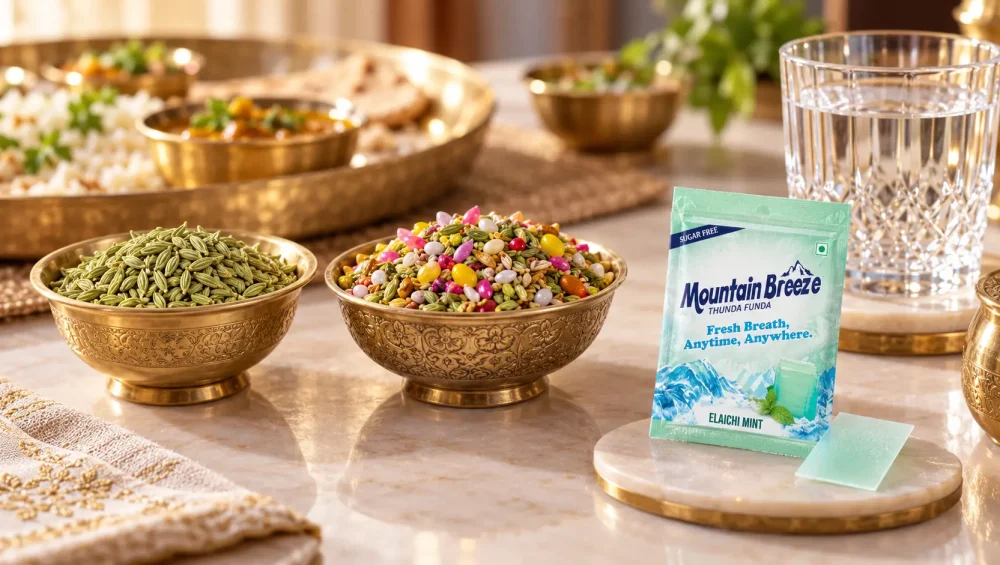
For many Indians, a meal does not quite feel finished until something fresh comes afterwards.
Sometimes it is a small bowl of plain saunf. At a restaurant or wedding, it may be colourful sweet mukhwas. And increasingly, people carry compact breath strips when they want something that can fit into a pocket or work bag.
All three are used for roughly the same moment, but they are not the same product.
Plain fennel seeds, sweet mukhwas and breath strips differ in ingredients, added sugar, flavour, convenience and the way they are used.
So if you are searching for a mouth freshener saunf option after meals, should you simply chew plain fennel seeds? Is sweet mukhwas better? Or does a modern dissolving breath strip make more sense?
There is no single winner for everyone.
Plain saunf is simple and traditional. Sweet mukhwas offers a more elaborate flavour and texture. Breath strips are designed around portability and quick use.
This guide compares all three so you can choose based on what actually matters to you.
What Is Saunf Mouth Freshener?
Saunf is the Hindi word commonly used for fennel seeds.
In India, fennel seeds are widely served after meals at homes, restaurants, weddings and other gatherings. Their naturally sweet, aromatic flavour makes them an obvious choice when you want to move away from the lingering taste of a heavy meal.
When people search for a saunf mouth freshener, however, they may be referring to several different things:
- plain fennel seeds,
- roasted fennel seeds,
- sugar-coated saunf,
- flavoured fennel seeds,
- fennel-based mukhwas, or
- a packaged mouth freshener containing fennel or similar aromatic flavours.
That distinction is important.
A spoonful of plain fennel seeds is very different from a brightly coloured sweet mukhwas containing sugar coatings, coriander seeds, sesame, coconut and flavourings.
If you want to understand those mixtures in more detail, read our guide to what is actually inside traditional mukhwas.
Plain Saunf vs Sweet Mukhwas vs Breath Strips: Quick Comparison
| Factor | Plain Saunf | Sweet Mukhwas | Breath Strips |
| Typical format | Whole fennel seeds | Mixture of seeds, coatings and flavours | Thin dissolving oral strip |
| Added sugar | None when completely plain | Often present, depending on the product | Depends on brand; Mountain Breeze strips are sugar-free |
| Chewing required | Yes | Yes | No |
| Portability | Needs a container or packet | Usually needs a pouch or container | Compact and pocket-friendly |
| Flavour | Mild, sweet and aromatic | Sweeter and more complex | Consistent flavour based on the chosen variant |
| Mess | Minimal, but seeds need to be carried | Can spill and may leave seeds in the teeth | No loose seeds |
| Best fit | Home and traditional after-meal use | Restaurants, celebrations and people who enjoy traditional mixes | Office, travel, meetings and on-the-go use |
Option 1: Plain Fennel Seeds as a Mouth Freshener
Plain fennel seeds are probably the simplest version of a traditional Indian after-meal mouth freshener.
There is very little mystery involved.
You take a small amount of saunf, chew it and experience its naturally aromatic flavour.
Because chewing itself stimulates saliva, having fennel seeds after a meal can also leave the mouth feeling less dry.
Most importantly, completely plain fennel seeds do not require an added sugar coating to taste mildly sweet.
Advantages of Plain Saunf
- Simple ingredient
- No added sugar when genuinely plain
- Traditional and familiar flavour
- Easy to keep at home
- Widely available
- No complicated preparation required
Limitations of Plain Saunf
The same simplicity that makes plain saunf attractive can also make it less convenient in certain situations.
You normally need a jar, pouch or small container to carry it.
The seeds need to be chewed, and small pieces can remain between the teeth.
It is perfectly practical at a dining table. It may feel slightly less practical five minutes before an office presentation or while sitting in an airport security queue.
That does not make saunf outdated. It simply means the ideal format depends on where you plan to use it.
Fennel is also one of several traditional ingredients discussed in our guide to natural mouth fresheners used for fresh breath.
Option 2: Sweet Mukhwas
Mukhwas takes the basic after-meal seed tradition and turns it into something more elaborate.
A typical mukhwas may combine ingredients such as:
- fennel seeds,
- sugar-coated fennel,
- sesame seeds,
- coriander seeds,
- dried coconut,
- flavourings,
- coloured coatings, and
- other ingredients depending on the recipe.
This gives mukhwas more texture, sweetness and variety than plain fennel seeds.
It is one reason the colourful bowl near the restaurant exit is so difficult to ignore.
Is Mukhwas the Same as Saunf?
No.
Saunf is fennel seed.
Mukhwas is a broader category of after-meal mouth freshener that may contain fennel along with several other ingredients.
Some mukhwas products are heavily based on fennel. Others contain only a small amount.
So when you see “saunf mukhwas” or “fennel mukhwas”, check what is actually in the mixture rather than assuming it is simply plain fennel.
What Is Sweet Saunf?
Sweet saunf usually refers to fennel seeds that have been coated, flavoured or combined with sweet ingredients.
This is different from plain fennel.
The bright pink, green, white or multicoloured fennel commonly served at restaurants may have coatings designed to make the product sweeter and more visually appealing.
If sugar intake matters to you, the colour of the product does not tell you enough.
Read the ingredient label.
A traditional-looking freshener can still contain substantial added sugar, while a modern product may be specifically formulated without sugar.
Does Sweet Mukhwas Contain Sugar?
Many varieties do, but not every mukhwas recipe is identical.
Some contain sugar-coated seeds, sugar crystals or sweetened ingredients. Others are based primarily on roasted seeds and spices.
This is why “mukhwas” should not automatically be treated as either sugary or sugar-free.
The ingredient list determines that.
From an oral-health perspective, frequent exposure to added sugars is worth considering because oral bacteria can metabolise sugars and contribute to the process involved in tooth decay.
If you regularly use a freshener several times during the day, checking for added sugar becomes more relevant than it might be for someone who has a small serving occasionally.
For a detailed comparison, see our guide to sugar-free mouth fresheners and oral health.
Option 3: Dissolving Breath Strips
Breath strips solve the after-meal freshness problem in a completely different format.
Instead of chewing seeds, you place a thin strip on your tongue and allow it to dissolve.
There are no loose seeds to carry, no spoon required and no chewing.
The primary advantage is convenience.
A strip pack can fit into a pocket, handbag, laptop bag or travel kit, making it easier to use when you are away from a dining table.
How Mountain Breeze Breath Strips Fit In
Mountain Breeze offers sugar-free dissolving fresh breath strips designed for portable use.
The strips dissolve on the tongue and are available across different flavours and pack formats.
You can see the current range on the Mountain Breeze product overview page or browse available packs in the Mountain Breeze mouth freshener collection.
A breath strip is not trying to imitate the texture of mukhwas or replace the cultural ritual of chewing saunf.
It is solving the same practical need through a more portable format.
Which Option Is Best for Fresh Breath After Food?
There is no useful answer that simply says one format is always best.
Think about the situation.
If You Are at Home
Plain saunf makes excellent practical sense.
You can keep a jar in the kitchen or dining room, take a small amount after food and return the jar to the shelf.
You do not need special packaging or portability.
If You Are at a Wedding or Restaurant
Mukhwas fits naturally into the occasion.
The mixture of flavour, sweetness and crunch is part of the traditional after-meal experience for many people.
If you are concerned about ingredients or added sugar, check the product rather than assuming every bowl contains the same mixture.
If You Are Going Back to Work
Portability becomes more important.
You may not want a container of fennel seeds sitting beside your laptop or small bits of mukhwas remaining in your teeth when you join a video call.
A dissolving strip is usually easier to use discreetly.
If You Are Travelling
Loose seeds are perfectly possible to carry, but they require packaging that stays closed.
Breath strips take up very little space and do not create loose crumbs inside a bag.
Which One Is Better After a Heavy Indian Meal?
Indian meals can contain strong flavours from garlic, onion, spices, pickles and rich gravies.
After a meal like that, each option offers a different experience.
Plain saunf gives you a mild aromatic flavour and something to chew.
Sweet mukhwas gives you a more noticeable combination of sweetness, flavour and texture.
Breath strips provide a concentrated freshening format without seeds or chewing.
Which one you prefer is ultimately a matter of flavour preference and convenience.
If your main concern is choosing something specifically after meals, our complete guide to mouth fresheners after food in India compares the wider range of options.
Plain Saunf vs Sweet Mukhwas: Which Has Less Added Sugar?
If the fennel seeds are genuinely plain and uncoated, they contain no added sugar.
Sweet mukhwas is more variable.
A product may contain:
- sugar-coated fennel,
- sugar crystals,
- sweetened coconut,
- candied ingredients, or
- other sweet coatings.
Another mukhwas could contain mostly unsweetened seeds.
So do not compare the categories purely by appearance.
Compare the actual ingredient labels.
What About Sugar-Free Breath Strips?
Sugar-free strips are another choice for people who want a prepared freshener without added sugar.
Mountain Breeze currently describes its dissolving mouth freshener strips as sugar-free.
That does not mean “sugar-free” should automatically be translated into “healthy” or “good for your teeth” without considering the complete product.
It simply means sugar is not being used in the same way as it is in conventional sugar-coated fresheners.
Good oral health still depends primarily on habits such as brushing properly, cleaning between the teeth and attending dental appointments when required.
Does Saunf Actually Remove Bad Breath?
This is an important distinction.
Plain fennel has a strong, pleasant aroma and chewing it can temporarily change the taste and smell in your mouth.
That is not the same thing as treating chronic bad breath.
If the underlying problem is:
- gum disease,
- tooth decay,
- a heavily coated tongue,
- dry mouth,
- tonsil stones, or
- another ongoing oral or medical issue,
chewing more fennel seeds will not remove that underlying cause.
The same principle applies to mukhwas and breath strips.
A freshener is useful for freshness. It should not be confused with dental treatment.
Is Saunf Better Than Mints?
It depends on what you mean by better.
If you want a whole spice with no added sugar, plain fennel may suit you.
If you want a stronger mint flavour in a packaged product, a mint or breath strip may be more convenient.
If you enjoy chewing and like the taste of fennel, there is no reason to abandon it simply because newer formats exist.
The purpose of comparing these options is not to declare traditional saunf obsolete.
It is to understand which format works best in different situations.
Does Chewing Saunf Help Digestion?
Fennel has a long history of traditional use after meals, including associations with digestive comfort.
That cultural use should not be confused with a guarantee that chewing a small amount of saunf will treat digestive problems.
If you are experiencing persistent acidity, stomach pain, bloating or another digestive symptom, a mouth freshener is not a substitute for appropriate medical advice.
For this comparison, the more relevant reason to choose saunf is its aromatic flavour and familiar after-meal experience.
Does Mukhwas Get Stuck in Your Teeth?
It can.
Small seeds and pieces in mukhwas can sometimes remain between teeth or in dental work.
The same can happen with plain fennel seeds.
This is usually more of a convenience issue than a reason to avoid the product entirely.
But it becomes relevant when you are choosing something immediately before:
- a client meeting,
- a presentation,
- a date,
- a photograph,
- an interview, or
- another face-to-face conversation.
A dissolving strip avoids the seed issue completely because there is nothing to chew.
Which Mouth Freshener Is Easiest to Carry?
Breath strips have the clearest advantage here.
You can certainly carry fennel or mukhwas in a small sealed container, but it adds another loose-food item to your bag.
A slim strip pack is specifically designed for portability.
This is useful for people who regularly move between:
- home and office,
- client meetings,
- college or university,
- restaurants,
- airports,
- train journeys, or
- social events.
The difference is not really about freshness here.
It is about format.
Which Option Gives the Most Consistent Experience?
Plain fennel is a natural agricultural product, so size, aroma and flavour can vary somewhat from batch to batch.
Mukhwas can vary even more because recipes differ significantly between brands, restaurants and regions.
A packaged breath strip is manufactured to provide a more standardised flavour and portion.
If you enjoy variety, that consistency may not matter.
If you want the same format every time you open the pack, it becomes an advantage.
Which One Should You Choose If You Avoid Added Sugar?
You have more than one option.
Plain uncoated saunf can be an excellent traditional choice because it does not require added sugar.
Sugar-free breath strips provide a portable packaged alternative.
Sweet mukhwas requires more attention because formulations differ considerably.
Do not assume:
“Seeds = sugar-free.”
Once coatings and additional ingredients are added, that may no longer be true.
Again, the ingredient label is more useful than the front of the packet.
Saunf Mouth Freshener vs Breath Strips for Office Use
This is one situation where lifestyle matters more than tradition.
Imagine you have just finished lunch.
You have a meeting in seven minutes.
If there is a bowl of plain saunf beside you, taking a pinch is perfectly reasonable.
If you are carrying your freshener around throughout the day, a compact strip pack is easier to manage.
No jar. No spoon. No loose seeds. No chewing.
That is the practical advantage of the modern format.
Saunf vs Breath Strips for Travel
The same principle applies during travel.
Fennel seeds travel perfectly well when stored in a good sealed container.
But if your goal is to carry as little as possible, breath strips require less space and create less mess.
They can be particularly convenient during:
- flights,
- train journeys,
- road trips,
- business travel, or
- long days away from home.
Can You Keep Both Saunf and Breath Strips?
Of course.
This comparison does not need to become an argument between traditional and modern products.
You might keep plain saunf at home because you enjoy it after dinner.
You might eat mukhwas occasionally at restaurants or celebrations.
And you might keep breath strips in your office drawer or travel bag.
Different formats can serve different situations.
That is often a more realistic way to choose than trying to declare one product universally superior.
How to Choose a Saunf or Mukhwas Product
If you are buying a packaged fennel-based mouth freshener, take a few seconds to check:
- Ingredient list: Is fennel actually the main ingredient?
- Added sugar: Are the seeds sweetened or sugar-coated?
- Other ingredients: What else has been added?
- Packaging: Is it hygienically sealed and easy to store?
- Flavourings: Are you buying plain saunf or a heavily flavoured product?
- Your use case: Is it for your dining table, office desk or travel bag?
The words “natural”, “traditional” or “mouth freshener” on the front of a pack do not tell you everything you need to know.
How to Choose Breath Strips
The same principle applies to modern fresheners.
Check:
- whether the product contains sugar,
- the ingredient information,
- available flavours,
- pack size,
- directions for use, and
- whether the format actually suits your routine.
Mountain Breeze’s current range includes multiple sugar-free dissolving fresh breath strip formats. You can compare the available options directly in the mouth freshener collection.
So, Which Is Better: Plain Saunf, Sweet Mukhwas or Breath Strips?
Choose plain saunf if you want:
- a simple traditional option,
- no added sugar when using plain uncoated seeds,
- a mild fennel flavour,
- something easy to keep at home, and
- the familiar experience of chewing fennel after food.
Choose sweet mukhwas if you want:
- a sweeter after-meal experience,
- more texture and variety,
- a traditional restaurant or celebration-style freshener, and
- a mixture rather than a single seed.
Just check the ingredient list if added sugar matters to you.
Choose breath strips if you want:
- something compact,
- no chewing,
- no loose seeds,
- consistent portions,
- easy office and travel use, or
- a sugar-free option such as Mountain Breeze strips.
Final Thoughts
The Indian habit of having something fresh after a meal is not disappearing.
What is changing is the number of choices available.
Plain saunf remains one of the simplest options. It is familiar, aromatic and easy to keep at home.
Sweet mukhwas turns that tradition into something more colourful, sweet and varied, although ingredients can differ significantly from one product to another.
Dissolving breath strips take the same after-meal need and package it for a more portable lifestyle.
None of these formats needs to defeat the others.
The useful question is:
Where will you actually use your mouth freshener?
At the dining table, you may happily choose plain saunf.
At a wedding, you may enjoy the mukhwas bowl.
Before an office meeting or while travelling, a dissolving strip may simply be easier.
Choose based on ingredients, added sugar, flavour and convenience rather than assuming every mouth freshener is basically the same.
Frequently Asked Questions
Is saunf a mouth freshener?
Yes. Fennel seeds, commonly called saunf in India, are traditionally chewed after meals because of their naturally sweet and aromatic flavour. Plain saunf is one of the simplest traditional after-meal freshener options.
Is saunf the same as mukhwas?
No. Saunf means fennel seeds. Mukhwas is a broader after-meal mixture that may contain fennel along with sesame, coriander, coconut, sugar-coated seeds, flavourings and other ingredients.
Does plain saunf contain added sugar?
Plain, uncoated fennel seeds do not have added sugar. However, sweet saunf and some fennel-based mukhwas products may contain sugar coatings or other sweetened ingredients.
What is sweet saunf?
Sweet saunf generally refers to fennel seeds that have been coated, flavoured or mixed with sweet ingredients. The exact formulation varies, so check the ingredient list if added sugar is important to you.
Is fennel mukhwas the same as fennel seeds?
Not necessarily. Fennel mukhwas usually contains fennel seeds as part of a mixture. It may also contain sugar, coatings, sesame, coriander, coconut, flavourings or other ingredients.
Which is better, saunf or mukhwas?
Plain saunf is better suited to someone who wants a simple single-ingredient option without added sugar. Mukhwas may suit someone who prefers a sweeter, more varied combination of flavours and textures. Neither choice is universally better.
Which is better, saunf or breath strips?
They serve the same general freshness occasion in different ways. Saunf offers a traditional chewing experience, while breath strips are compact, do not require chewing and are easier to carry in many work or travel situations.
Can saunf cure bad breath?
No. Saunf may provide temporary aromatic freshness, but persistent bad breath can have underlying causes such as gum disease, tooth decay, dry mouth, tongue coating or other conditions. Those problems require appropriate oral care or professional assessment.
Are breath strips sugar-free?
It depends on the product. Mountain Breeze currently describes its dissolving fresh breath strips as sugar-free. Always check the label when comparing different brands or formats.
Is sweet mukhwas bad for teeth?
Mukhwas formulations vary. Products with added sugar contribute to sugar exposure in the mouth, which is relevant to tooth-decay risk when sugary products are consumed frequently. Check the ingredient list and maintain normal brushing and interdental cleaning.
What is the best mouth freshener after an Indian meal?
The best choice depends on your priorities. Plain saunf is simple and traditional, mukhwas offers more flavour and texture, while dissolving strips are particularly convenient for office, travel and situations where you want a portable no-chewing format.
Can I use saunf at home and breath strips outside?
Yes. There is no need to use only one format. Many people may prefer plain fennel seeds after meals at home while keeping a compact mouth freshener product available for work, travel or social situations.
Disclaimer: This article is for general educational purposes and should not be considered dental or medical advice. Mouth fresheners can provide temporary freshness but do not replace brushing, interdental cleaning or professional dental care. Persistent bad breath should be assessed by a qualified dentist or healthcare professional.


