
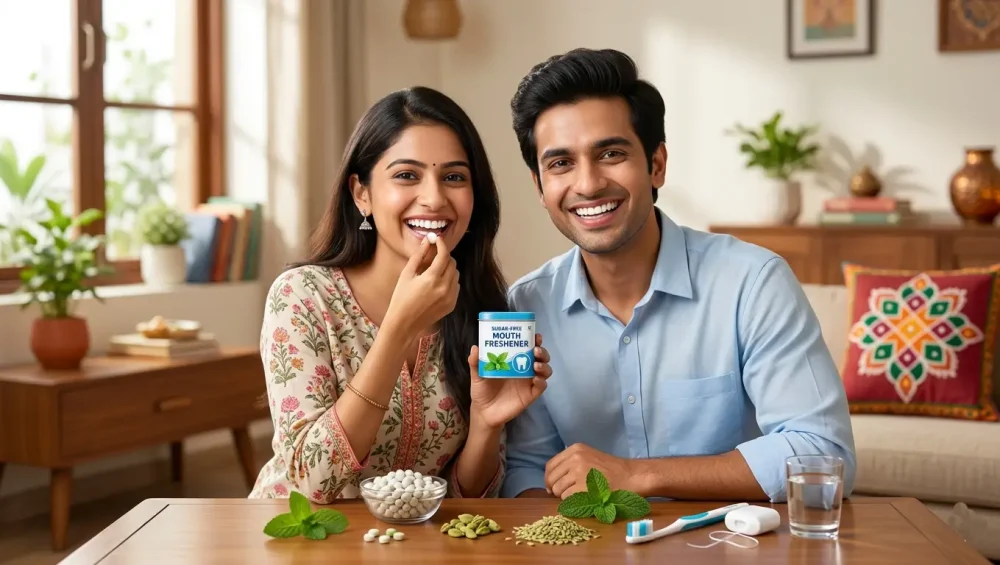
The Hidden Problem with Most Indian Mouth Fresheners
Walk into any Indian restaurant, wedding, or festive gathering, and you’ll find a bowl of mukhwas near the exit. These colorful seed mixtures are a beloved tradition — but most of them contain sugar. Glazed fennel seeds, sugar-coated cardamom, candied coriander — all delicious, all carrying a hidden cost for your teeth. For context on mukhwas ingredients and their effects, see our complete mukhwas guide.
The same applies to most packaged mints and breath candies. Even products that claim to be ‘refreshing’ or ‘natural’ often contain sugar as one of their primary ingredients. For people who reach for a mouth freshener multiple times a day, this adds up to significant repeated sugar exposure that most people never consider. See also: Are Mouth Fresheners Beneficial for Oral Health?
Related reading: The Reality of Sugar-Free Mints for Your Oral Health
What Happens When You Use Sugary Mouth Fresheners Regularly
The mouth is home to hundreds of bacterial species. Among them, certain bacteria — particularly Streptococcus mutans — feed specifically on sugar. When you consume a sugary mint or mukhwas, these bacteria begin metabolizing the sugar, producing acidic byproducts that temporarily lower the pH of your mouth, softening and eroding tooth enamel. To understand how oral germs work in more depth, see: How Germs in Teeth Affect Your Oral Health
Here’s what makes this particularly problematic with mouth fresheners specifically:
- You use them between meals — when saliva is lower and the mouth’s natural buffering is reduced
- They sit in contact with teeth longer — hard candies and slow-dissolving mints mean prolonged sugar exposure
- You use them frequently — multiple times per day means multiple acid attacks on enamel
- People don’t brush after using them — unlike after meals, nobody brushes after a post-lunch mint
The irony is significant: you’re using a breath freshener to improve oral hygiene, while simultaneously feeding bacteria that cause the exact same bad breath you’re trying to eliminate.
How Sugar-Free Mouth Fresheners Break This Cycle
A sugar-free mouth freshener delivers freshness without providing food for odor-causing bacteria. When there’s no sugar to metabolize, the bacteria don’t produce acids, enamel stays protected, and the overall oral environment remains more balanced between uses.
Some sugar-free sweeteners like xylitol actually go further — research suggests xylitol can actively inhibit the growth of Streptococcus mutans. This means certain sugar-free mints not only avoid harm but may provide a mild protective benefit. For a full breakdown of how breath strips specifically support oral hygiene, read: How Breath Strips Support Better Oral Hygiene Between Brush Cycles
Types of Sugar-Free Mouth Fresheners Available in India
Sugar-Free Dissolving Strips
The most convenient and increasingly popular option in urban India. Products like Mountain Breeze breath strips are completely sugar-free, dissolve in seconds, and leave no residue. Because they don’t require chewing, they don’t trigger prolonged contact with teeth the way gum or slow-dissolving mints do. Want to understand exactly how these strips work? See: What Is Paper Mint? A Complete Guide to Dissolving Strips
In-depth comparison: Mouth Freshener Strips vs Chewing Gum: Which Is Better for Oral Hygiene?
Sugar-Free Chewing Gum
Widely available and effective, particularly at stimulating saliva through the chewing action. Look for gum with xylitol as the primary sweetener. Avoid brands where sugar appears on the ingredient list, even in small quantities.
Plain Seed-Based Mukhwas (No Sugar Glaze)
Plain roasted fennel seeds, cardamom pods, and coriander seeds without any sugar glaze are a traditional sugar-free option. The natural oils in fennel and cardamom have real odor-neutralizing properties, and the chewing stimulates saliva. The challenge is that most commercially packaged mukhwas adds sugar coatings. Read more in our Mouth Freshener After Food in India Guide which covers how to choose the right post-meal option.
Sugar-Free Mouth Sprays
Available in pharmacies and online, these deliver an instant burst without sugar. However, some contain alcohol, which can temporarily dry the mouth — counterproductive since dryness worsens bad breath. Look for alcohol-free, sugar-free sprays if this format appeals to you.
How to Read Labels: Spotting Hidden Sugar in Mouth Fresheners
- Sucrose, glucose, fructose, dextrose — all forms of sugar, avoid these in mouth fresheners
- Maltitol — a sugar alcohol that some research links to elevated insulin response; use in moderation
- Sorbitol, xylitol, erythritol — better sugar alternatives with lower glycemic impact
- ‘Natural flavors’ or ‘mixed sweeteners’ — check quantity; if listed early, significant amount is present
- ‘Sugar glazed,’ ‘candy coated,’ ‘sweet coated’ — means there’s sugar on the surface
Sugar-Free Mouth Fresheners and Special Dietary Needs
For Diabetics
Frequent sugary mints can cause small but repeated blood sugar spikes — a concern for Type 1 and Type 2 diabetics who monitor intake carefully. Sugar-free strips and mints allow you to maintain fresh breath without any impact on blood glucose levels.
For Keto and Low-Carb Diets
Even small sugar inputs can interrupt ketosis in strict practitioners. Sugar-free mouth fresheners allow keto followers to maintain freshness — including managing the ‘keto breath’ that low-carb diets sometimes cause — without breaking their dietary state.
For Children
Children’s teeth are more vulnerable to acid erosion than adults’. Replacing sugary mints and candies given to kids with sugar-free alternatives is a straightforward way to reduce cavity risk. See our complete guide: Are Mouth Fresheners Safe for Kids? Guidelines for Parents
Mountain Breeze: Sugar-Free Across All Variants
Every variant of Mountain Breeze mouth freshener strips — Coolmint, Spearmint, and Paanmint — is completely sugar-free. The strips are made using Orally Disintegrating Strip technology with food-grade, vegetarian ingredients and zero sugar in any form. This makes them suitable for daily use multiple times a day without the dental health trade-offs that come with traditional sugary mints or mukhwas.
Explore the full range: Shop Sugar-Free Mountain Breeze Strips — all flavours
Building a Sugar-Free Oral Freshness Routine
- Morning — brush, floss, tongue clean as usual
- After breakfast — use a sugar-free strip before leaving home or starting work calls
- After lunch — use a strip instead of reaching for mukhwas or a sugary mint
- Mid-afternoon — if needed after tea or coffee, use a strip
- Evening / after dinner — one strip before social plans, then brush before bed
Learn why timing matters: Late Night Snacking and Its Impact on Breath Health
Frequently Asked Questions
Is sugar-free mouth freshener safe for daily use?
Yes. Sugar-free dissolving strips are designed for daily frequent use. They do not harm enamel, do not feed odor-causing bacteria, and complement regular brushing. Read more: How Breath Strips Support Better Oral Hygiene Between Brush Cycles
Which sugar-free mouth freshener is best in India?
Mountain Breeze dissolving strips are among the best sugar-free options available in India — completely sugar-free, vegetarian, in three flavours, and available online. Browse the full range here.
Is mukhwas sugar-free?
Most commercial packaged mukhwas is not sugar-free. Plain roasted seeds without coating are naturally sugar-free. Read our complete mukhwas guide for more detail.
What is a good sugar-free mouth freshener for diabetics?
Dissolving strips sweetened with sorbitol or other non-sugar sweeteners are the best option for diabetics. Mountain Breeze strips are sugar-free and do not impact blood glucose. Shop here.
Can I use sugar-free mints on keto?
Yes, properly sugar-free mints will not break ketosis. Ensure the product is genuinely sugar-free and not sweetened with maltitol in large quantities. Dissolving strips with mint oil and sugar-free sweeteners like sorbitol are generally keto-compatible.


